

Commentary
Gwendolyn Sasse
{
  "authors": [
    "Gwendolyn Sasse"
  ],
  "type": "commentary",
  "blog": "Strategic Europe",
  "centerAffiliationAll": "",
  "centers": [
    "Carnegie Endowment for International Peace",
    "Carnegie Europe"
  ],
  "englishNewsletterAll": "",
  "nonEnglishNewsletterAll": "",
  "primaryCenter": "Carnegie Europe",
  "programAffiliation": "",
  "regions": [
    "Europe",
    "Russia",
    "Germany"
  ],
  "topics": [
    "EU",
    "Democracy",
    "Disinformation",
    "Civil Society"
  ]
}
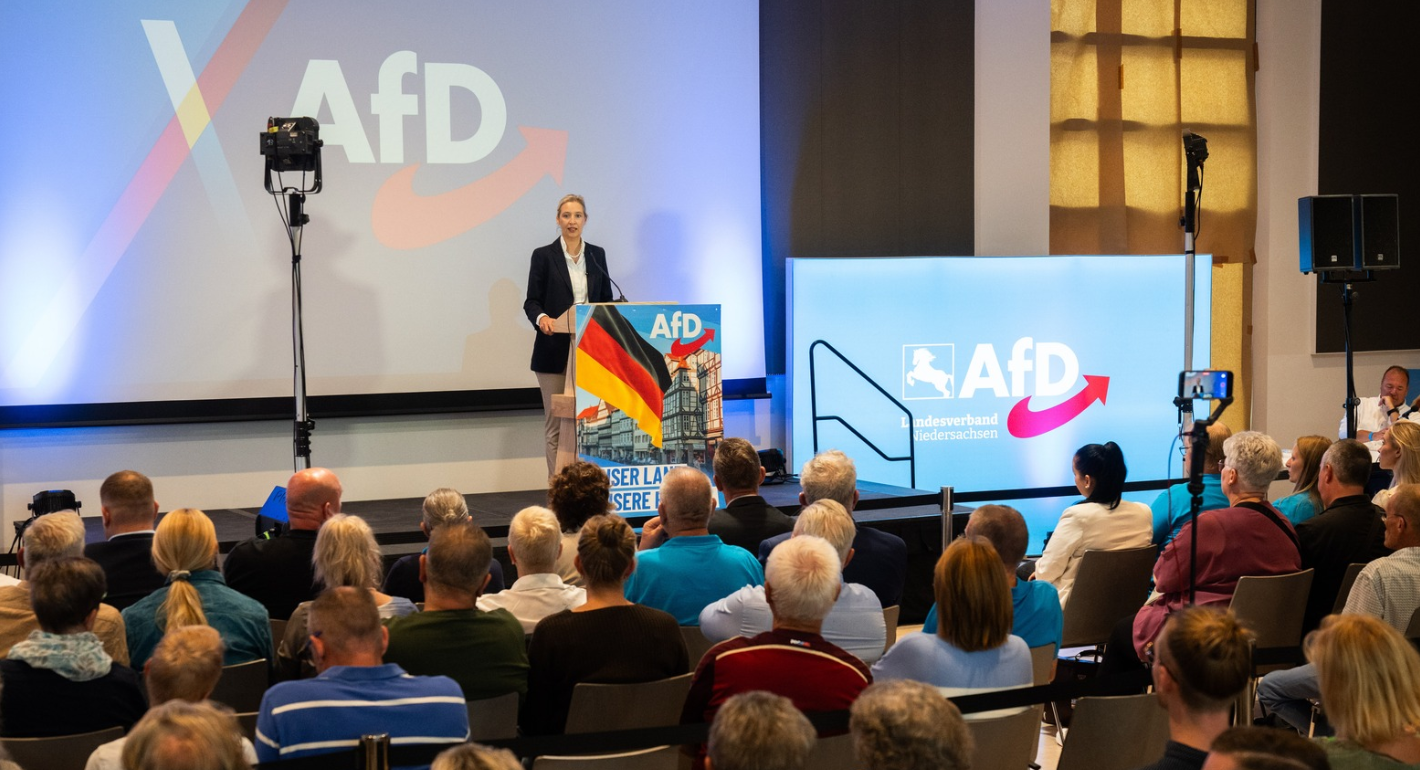
Source: Getty
In Germany, competing perceptions of Russia are highlighting a tension between public opinion and government policy. In the country’s east, where division is widespread, populist parties are taking advantage.
The electoral results of parties like the Alternative for Germany (AfD), Alliance for Social Justice and Economic Reason (BSW), and The Left in recent state elections in Germany have demonstrated the potency of pro-Russian policies and narratives for the country’s electorate. The platforms of all three parties prominently featured rhetoric that was notably positively inclined toward Russia.
The election program of the AfD in the eastern state of Saxony-Anhalt went furthest, demanding a revival of Russian-language teaching and school exchanges in addition to an end to sanctions and the resumption of close energy relations. It also reduced Russia’s full-scale war against Ukraine to the status of “simmering.” All three parties loudly called for peace and diplomacy—without any indication of how to open a meaningful diplomatic channel.
The strategy here is not to deliver on these objectives but to tap into uncertainty, fear, and anger in order to mobilize voters. The varying successes of the three parties are, of course, not only the result of prominent references to Russia, but also of a now-embedded contestation over Germany’s support for Ukraine and future relations with Moscow acting as a new political cleavage.
It seems paradoxical that pro-Russian views have such popular appeal at a time when Moscow’s hybrid attacks on Germany and other European countries have been on the rise. After all, the explosive-laden drone found at Leipzig airport in August, 2026, had marked a new stage in the confrontation. For the first time, Berlin clearly attributed the attack to Russia and the head of the German foreign intelligence service subsequently spoke of an ongoing “shadow war.”
The paradox is part of a new iteration of Germany’s Russia complex, which has historically seen Berlin waver between the extremes of enmity and cooperation. This time around, views on appeasing Moscow are not only rooted in a fear of military escalation but also tied to the assumption that military spending and support for Ukraine undermine social policy and long-overdue structural reforms. This despite the government separating the budgetary logics for both types of spending in order not to pit one against the other.
Germany is not the only European country where support for Ukraine and an increase in military spending have become contested, but the framing of Russia-friendly views in terms of history and culture has a specific salience in the country’s discourse. Moreover, it is wrapped up in a continued juxtaposition between eastern and western regions, despite the fact that these regional and political denominations have become fuzzy as a result of mobility as well as structural and generational change. A softer reinterpretation of the Soviet-controlled German Democratic Republic functions as an instrument to build distance to western Germany and an idea of closeness to Russia. Such arguments create a space for projections which have little to do with eastern Germany’s Soviet past or Russia’s political actions today.
Instead, different historical paths led to Russia-friendly or Russia-blind attitudes in east and west. A shared positive memory of rapprochement under former Soviet premier Mikhail Gorbachev continues to cloud current assessments of Russia. He remains a prominent reference point in discussions about Russia across Germany. The experience of post-1989 transformation provides convenient building blocks for an image of alleged closeness to or expertise on Russia—although citizen-level contact was and is extremely limited. The fact that the populist and extremist parties using such narratives are, for the time being, more successful in eastern Germany can be explained by the higher level of alienation and resentment there that is linked to the memory of that transformation—but it is, above all, a difference in scale and timing.
In Germany, the debate about Russia has become a vehicle to position oneself against the national government and the traditional parties. It is a particularly striking proof that in politics, perceptions matter and can develop their own dynamics. Recognizing this is critical to understanding the presence and simultaneous absence of the real Russia in the public debate. Even Chancellor Friedrich Merz has pointed to widespread misconceptions about Russia in Germany. At the level of the national government, perceptions and policies have changed since 2022, but a significant gap remains between the national government and society at large. Opinion polls, focus groups, and in-depth interviews with citizens provide ample evidence of this.
Germany’s Russia policy over the last decades has been critically examined by a number of studies and several political actors have called for an official investigation. However, government policy is not formulated in a vacuum but in close interaction with society. Therefore, a bottom-up view focusing on perceptions of Russia deserves more attention. An explicitly positive image of the country’s President Vladmir Putin has been drowned out by his full-scale invasion of Ukraine, and an ambivalent image of his country has taken its place. There is not only a widespread self-reported lack of knowledge about Russia but also a tangible lack of interest in—even outright avoidance of—its domestic politics and foreign policy. Against this backdrop, populist and extremist parties manage to mobilize voters on the basis of emotions and vague calls for peace or better living standards through normalization with Russia. This gap between perceptions, wishful thinking, and an attitude of burying your head in the sand on the one hand and political reality on the other makes Germany a prime target for Russian disinformation campaigns and poses a risk to democracy. It is also a significant obstacle to developing a whole-of-society understanding of security that goes beyond the military dimension.
Subscribe to Strategic Europe, delivered every Tuesday and Thursday!

Nonresident Senior Fellow, Carnegie Europe
Gwendolyn Sasse is a nonresident senior fellow at Carnegie Europe. Her research focuses on Eastern Europe, with a particular focus on Ukrainian politics and society, EU enlargement, and comparative democratization.
Recent Work
Gwendolyn Sasse
Gwendolyn Sasse
Carnegie does not take institutional positions on public policy issues; the views represented herein are those of the author(s) and do not necessarily reflect the views of Carnegie, its staff, or its trustees.
The European Commission is preparing the EU for its next enlargement. But member states need to make it a project that European citizens can understand, shape, and support.

Iliriana Gjoni
Resetting relations with the EU is a central plank of the UK’s current foreign policy. Is Andy Burnham being bold enough or is he falling into the same trap as his predecessors, misreading the power dynamic?

Rym Momtaz, ed.
Excitement is in the air following Aleksandar Vučić’s defeat in Serbia. To build a truly democratic state, the movement that unseated the former president must learn from the mistakes of the past.

Ivan Vejvoda
The EU can impose sanctions but struggles to enforce them without the United States. With Washington increasingly disinterested in backing European interests, the bloc must now fend for itself.
Nicu Popescu, Tiago Antunes
Russia is testing the waters of NATO’s mutual defense clause. What do strikes in Romanian territorial waters mean for the alliance’s posture toward Moscow?

Dimitar Bechev