

Commentary
Galina Yuzefovich
{
  "authors": [
    "Galina Yuzefovich"
  ],
  "type": "commentary",
  "blog": "Carnegie Politika",
  "centerAffiliationAll": "",
  "centers": [
    "Carnegie Endowment for International Peace",
    "Carnegie Russia Eurasia Center"
  ],
  "englishNewsletterAll": "",
  "nonEnglishNewsletterAll": "",
  "primaryCenter": "Carnegie Russia Eurasia Center",
  "programAffiliation": "",
  "regions": [
    "Russia"
  ],
  "topics": [
    "Domestic Politics"
  ]
}
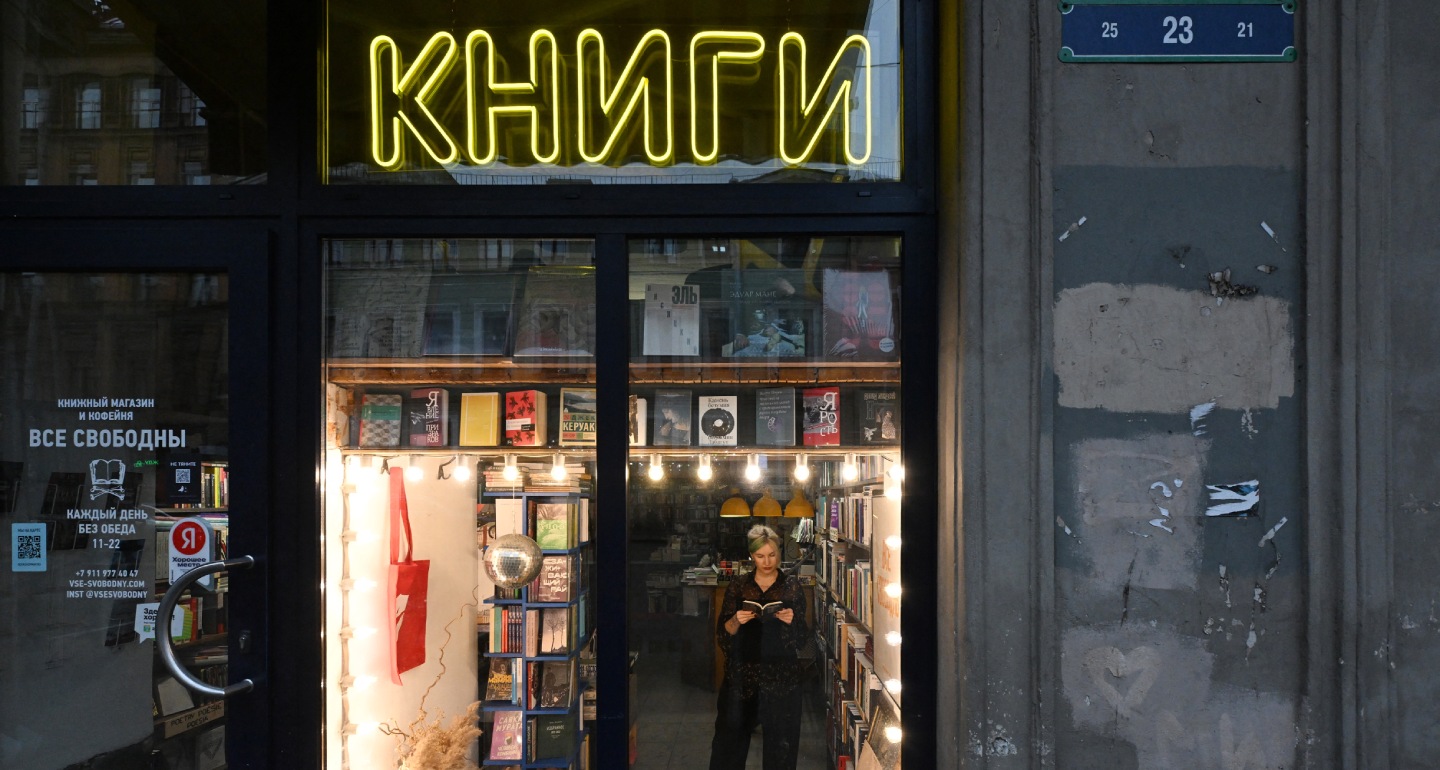
Source: Getty
Political pressure and economic headwinds are closely intertwined problems for Russian publishers and booksellers. Together, they risk propelling Russia into a “post-literate” era.
A systemic crisis is engulfing the Russian book industry. On top of familiar woes like higher taxes, price increases, censorship, the departure of Western rights-holders, and the impossibility of using social media to promote books, there has been a steady stream of new issues. Most recently, Ukrainian drone attacks on the warehouses of e-commerce giants resulted in tens of thousands of books going up in flames.
The structure of Russian publishing and bookselling has changed dramatically in the last few years. In particular, the number of books sold via Wildberries and Ozon (the Russian equivalents of Amazon) has risen, with such online marketplaces accounting for 60 percent of book sales in June 2026. However, that does not mean that the market is growing, just that buyers gravitate to outlets offering cheaper books.
To some extent, the shift to online book sales in Russia is part of a global trend. Amazon has changed consumer habits and destroyed the business model of many traditional bookstores in the West. In Russia, this process started much later and is unfolding much faster. A record rise in the price of books in Russia is supercharging the reluctance to go to bookstores. In the first three months of 2026, book prices increased 18.5 percent faster than in the same period a year earlier, according to the Digital Development Ministry (which oversees publishing and bookselling).
Now, marketplaces are expected to raise their prices (perhaps to the same level as bookstores), and that means fewer books being sold.
As price rises outstrip broader income growth, people are switching to reading books they already own (home libraries remain larger than average in Russia) or using public libraries (visits to libraries rose by a record 7.5 percent in 2025).
Inevitably, these behavioral changes have knock-on effects. The Digital Development Ministry report stated that the total number of books published in 2025 dropped 11 percent from the previous year, and that total print runs fell 26 percent. The trend looks like it will continue in 2026, with average print runs falling 16.9 percent in the first three months.
A distinction is often made between the political and economic problems facing the Russian book industry. However, the former almost always bleed into the latter, with political restrictions increasing costs for publishers, booksellers, and buyers. For example, publishers are submitting fewer applications for books to be sold at a reduced rate of VAT (books classed as “socially significant” and pertaining to science, culture, or education are eligible for the reduced rate) because of the risk of attracting unwanted official attention and falling foul of censorship.
Similarly, bookstores are ineligible for tax breaks on their property rental costs if they stock books by authors tarred with the label of “foreign agent,” or books produced with the help of “foreign agents” (editors, translators, or illustrators). The complexity of the system means avoiding all “foreign agents” is an impossible task. Furthermore, if a bookseller with tax breaks is caught selling “foreign agent” books, then they are likely not only to lose the tax breaks, but to be fined.
Even so, “foreign agent” books are far from the biggest source of risk. Books produced with the aid of “undesirable organizations” are much more dangerous for publishers and booksellers. Not only does the official list of “undesirable organizations” continue to grow, but designations are backdated to the moment the organization first appeared.
This means that publishers, libraries, or bookstores can be penalized for having old books linked to newly designated “undesirable organizations.” In one example, the European University at St. Petersburg was fined because its library contained monographs published in the 1990s with support from U.S. foundations now deemed “undesirable.” In another, independent bookstores Falanster (in Moscow) and Podpisnye Izdaniya (in St. Petersburg) were fined for stocking On the Way to Magadan, a book by the Belarusian activist Ihar Alinevich that was published in 2013 with support from the now-banned Anarchist Black Cross Federation.
A joint report released in June by the Digital Development Ministry and Oleg Novikov, the owner of the country’s biggest publisher, Eksmo-AST, hinted that if the law on “undesirable organizations” were followed to the letter, it would mean public and academic libraries losing up to 15 percent of their books. Some municipal libraries could lose up to 70 percent. Ironically, many of these books would likely be Russian classics that were obtained by libraries in the 1990s with the financial support of Western organizations. The process of withdrawing books and rehousing them in special collections closed to the public is ongoing.
Even riskier than books linked with “undesirable organizations” are books containing “LGBT propaganda.” In the deft hands of Russian propagandists, publishing or selling such books can easily be portrayed as cooperating with a purported “international LGBT public movement” that has been deemed “extremist” by Russia’s Supreme Court. While the punishment for peddling “LGBT propaganda” is initially just a fine, a conviction for cooperating with an “extremist” organization would likely result in a custodial sentence.
Fines of 800,000 rubles ($9,600) for LGBT propaganda have been levied on Falanster for stocking Per Faxneld’s Satanic Feminism, on Podpisnye Izdaniya for selling books by Susan Sontag and Olivia Laing, and on the chain Chitai-Gorod for Beartown by Fredrik Backman and The Left Hand of Darkness by Ursula K. Le Guin (although the latter fine was subsequently reduced to 400,000 rubles on appeal).
These are huge sums for small retailers. While big or popular bookstores can cope (Falanster, for example, raised the money to pay its fine in one weekend when loyal customers bought a record number of books), a single fine can bankrupt bookstores in regional cities. Censorship and the associated risks were among the reasons given by owners for the closure of Bukvalno in the Urals city of Yekaterinburg, and Svoya Komnata in Siberia’s Ulan-Ude.
For the time being, the book industry has only seen one LGBT-related case of extremism charges. Three staff members at publisher Popcorn Books were arrested in April 2025 on charges of participating in an extremist organization (essentially for distributing books with LGBT topics). After a year under house arrest, they cut a deal with prosecutors, gave evidence against senior managers at Eksmo-AST (which purchased Popcorn Books in 2022), and were handed suspended sentences. This led to searches at Eksmo, and director Yevgeny Kapyev was briefly detained. As of August 2026, the case remained open.
Since it came into force on March 1, 2026, however, the most damaging law for publishers and booksellers has been a ban on the “propaganda of drugs in literature and art.” If the law on “LGBT propaganda” affected hundreds of titles, then the law on the “propaganda of drugs” has had consequences for tens of thousands, if not hundreds of thousands.
The law (which is also backdated) means that publishers have been reviewing entire catalogs and recalling “suspicious” titles from stores. Some of these titles will be returned to sale, some given a warning sticker, and some permanently removed.
The outcome depends on whether a book has “plot-driven mentions” of drugs (in which case it needs a warning sticker and can only be sold to readers aged eighteen and over), or whether it contains “propaganda” of drugs (in which case it is banned). A failure to remove banned titles can be punished by a fine and confiscation of the entire print run. Repeat offenders can be sentenced to two years in jail.
The impossibility of distinguishing “plot-driven mentions” from “propaganda” has caused panic in the industry. Since the details of the law became known in 2025, many publishing staff have spent most of their time looking for drug references in long-published books. While AI has sped up this process, the sheer quantity of identified references has created a bottleneck.
To minimize the risk of violating the law, publishers initially halted the sale of a broad swath of books—and Russian media was filled with absurd reports of classics disappearing from the shelves. These included the works of Lenin, and books by Denis Dragunovsky (AI flagged up his surname as possibly being linked to the word “drug”).
As many older books no longer have rights-holders, some of the burden of this tedious work has also fallen on booksellers. After all, booksellers are regularly subjected to inspections, and are targeted by security service officers posing as customers. Over the winter, some bookstores closed early so that staff could check their stock for drug references.
Amid all this censorship, reports have emerged that the book industry is finding it hard to retain staff—perhaps the most serious indicator of a looming crisis. In an interview aired on July 28, Eksmo-AST owner Oleg Novikov said: “We have had to revise a lot of internal regulations, instructions, and accountability procedures … some people couldn’t handle this work. There were employees who quit. Others we dismissed because they weren’t prepared—or, one might say, were unwilling—to meet the current legal requirements.” His dry words hide nothing less than a tragedy for Russian publishing.
Those who work in bookselling or publishing do not have large salaries. Until recently, this was offset to some extent by relative freedom and a general sense of purpose—even nobility. But now for many in publishing and bookselling, the requirements of state censorship have stripped their jobs of meaning.
In combination with global negative trends in the book industry, the Kremlin’s censorship could end up being catastrophic for publishing in Russia. An article by Rose Horowitch published at the end of June in the Atlantic, titled “The End of Reading Is Here,” described a lot of the dynamics with which people working in the book industry have been familiar for years. In brief, Horowitch argued that reader numbers are falling, and that people’s ability to process long texts—let alone complex ones—is declining. Reading as a concept, and books as that concept’s material (or virtual) embodiment, are in their twilight years. The intrusion of AI is eroding the notion of literature and shattering the remnants of mutual trust between writers and readers.
Some of Horowitch’s arguments and conclusions are open to debate, but she correctly identifies the direction of travel: The space for reading is shrinking at the same time as it is being transformed. Humanity is entering what the Canadian philosopher Marshall McLuhan once dubbed the “post-literate” era. Every blow struck against books today could be fatal.
Accordingly, the carpet-bombing of the Russian book industry carried out by the Kremlin in recent years will soon become irreversible—if indeed it isn’t already. Without a change of direction, Russia risks becoming one of the first countries to enter the post-literate era.

Literary critic
Recent Work
Galina Yuzefovich
Galina Yuzefovich
Carnegie does not take institutional positions on public policy issues; the views represented herein are those of the author(s) and do not necessarily reflect the views of Carnegie, its staff, or its trustees.

In the discussions made possible by the State Duma election campaign, one question is being asked more and more loudly. “What next?”

Andrey Pertsev

While the Nazis rushed ahead in a revolutionary fervor, Russia’s modern crusaders against enemies of the state work methodically, giving their targets time to adjust to restrictions before closing the loopholes.

Leonid Bershidsky

When faced with fuel shortages in the past, Central Asian governments could always count on additional supplies from Moscow. That safety net no longer exists.

Galiya Ibragimova

Reading the purported correspondence of celebrity Ksenia Sobchak sheds light on her role within the system, and how journalism and politics function in Putin’s Russia.
Vladislav Gorin

When political power is concentrated in the hands of a small circle of people, a country invariably ends up with technological stagnation.
Aleksei Kiselev